


Podcasts for delivery of medical education
Creating and releasing podcasts was an effective alternative to traditional face-to-face education during the COVID-19 pandemic.


Background

- Podcasts have continued to grow in popularity since the term was coined in 2004 ¹ and are increasingly being recognized as an important tool for continuing medical education (CME). ²
- HIV in Podcast Australia is a podcast designed to enhance the medical education of healthcare professionals (HCPs) caring for patients with HIV in Australia. The series was launched in 2018 via a dedicated CME and networking platform ³ for HCPs in Australia.
- Following the success of this pilot project, we explored the use of podcasts distributed via the purpose-built app in Podcast (launched in July 2019) as a medium for medical education for HCPs in different countries.
Methods
- Bite-sized episodes (approximately 10–20 minutes each) on contemporary and region-specific medical topics were created across five series. Podcast names, including therapy areas, are shown in Table 1.
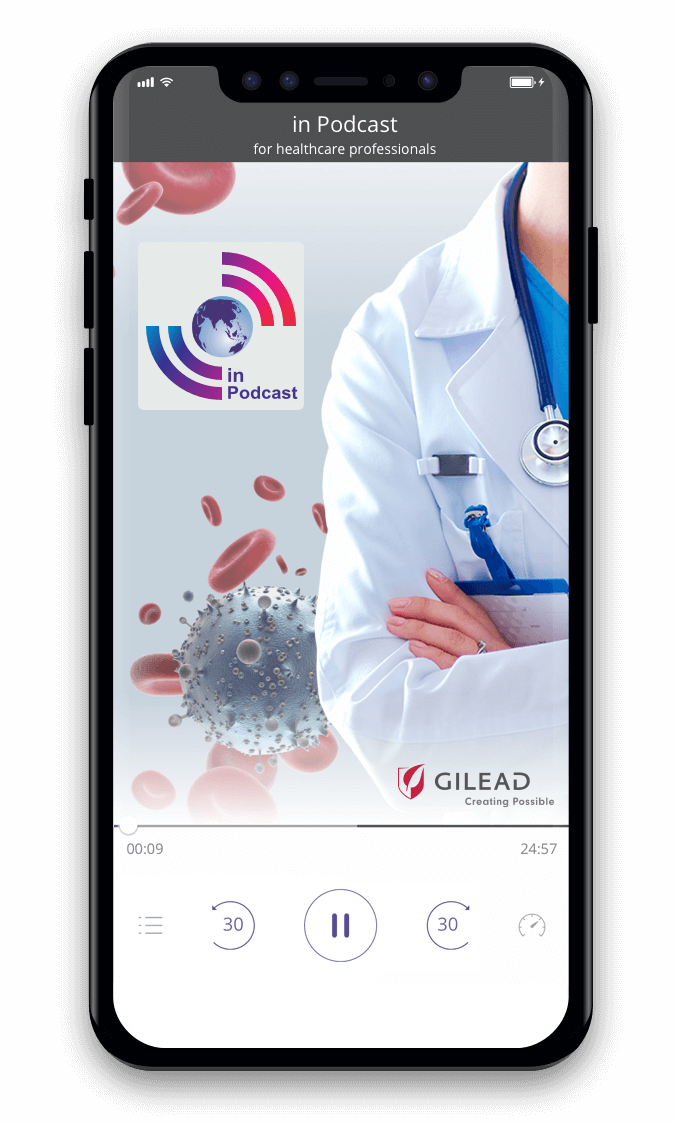
- All podcasts were accessible via the in Podcast app (available as an Apple or Android app), which was hosted by Podbean, a global podcast-hosting platform that has been approved under the European General Data Protection Regulation (GDPR).
- Web-based access to podcast content via the Podbean website was also provided.
-
Audiences were generated via electronic or hard copy mail-outs to eligible HCPs, printed adverts, and promotion at scientific meetings (Table 1).
- Electronic mail-outs were delivered to a list of HCPs (~500 subscribers) for HIV in Podcast Australia using the Mailchimp platform.
- Hard copy mail-outs (~3100 subscribers) and electronic mail-outs (~1800 subscribers) for Hepatology in Podcast Australia were managed by an external partner.
- Printed adverts were published in peer-reviewed journals (circulation: ~500 copies) or scientific magazines (circulation: ~5000 copies) with a global audience reach.
- Promotional activities at scientific meetings included setting up in Podcast booths and handing out flyers.
-
Potential users were directed to a registration page, which verified their HCP status in accordance with country-specific regulations.
- Following verification of their status, HCPs were provided with instructions on how to access the podcasts via the in Podcast app.
-
Uptake was measured by analysing the following digital metrics provided by Podbean.⁴
- Number of audio file downloads (i.e. user requests an audio file from the server and receives the whole file for offline listening) or live streams.
- Number of unique users who downloaded an audio file or live streamed content.
- Percentage user engagement,⁵ which refers to the proportion of the audio file that the user listens to, calculated using the following formula.

-
- Mean user play time for each audio file was calculated using the following formula.

- Percentage user engagement can exceed 100% if users listen to all or part of an audio file multiple times.
Results and discussion
-
Across all series, most audio file downloads (≥ 86%) took place via the dedicated Podbean app.
- This suggests that users prefer the convenience of the app over other platforms (e.g. Chrome, Firefox) when accessing audio files.
-
The number of audio file downloads grew steadily over time across most podcasts (Figure 1a and Table 1).
- HIV in Podcast Australia and Hepatology in Podcast Australia reported a higher mean number of downloads per month compared with the other podcasts (Figure 1b).
-
The increase in the number of downloads over time is likely due to the increasing number of unique users across most podcasts since launch (Figure 2a and Table 1).
- Hepatology in Podcast Australia reported the highest mean number of users per month (Figure 2b).
-
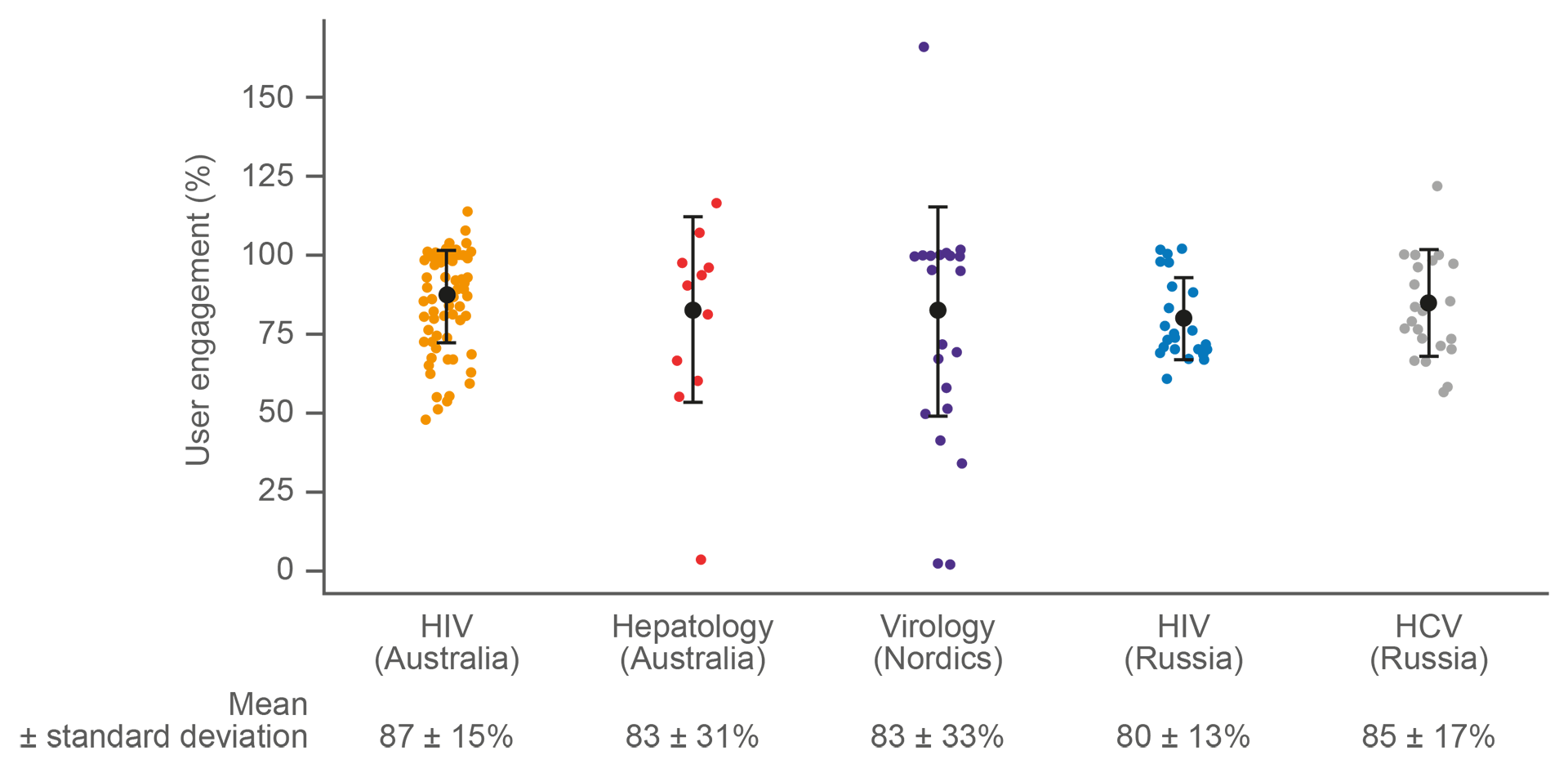
Mean percentage user engagement was generally high (80–87%) across the different series, with variations in percentage user engagement reported for individual audio files (Figure 3).
- In some instances, we observed users listening to sections of the audio file more than once, which likely contributed to the high overall mean percentage engagement.
-
Our data suggest that promotional strategies such as electronic and/or hard copy mail-outs might improve podcast uptake (number of downloads and unique users).
-
Podcast uptake could also be affected by regional differences. For example, CME might be less important to HCPs in the Nordics, whereas HCPs in Australia can claim continuing professional development (CPD) points when engaging with ASHM-accredited education resources (e.g. HIV in Podcast Australia).
Figure 1
(a)

Show Figure 1 details
Total downloads have increased over time across all podcast series.
a) Cumulative total downloads for each podcast series since launch. b) Mean downloads per month for each podcast series (calculated by dividing the total downloads by the number of months since launch).
Utilize sliders on charts to zoom in on data points and click on the names of the podcasts to highlight data for individual podcasts.
Au, Australia; Hep, Hepatology; No, Nordics; Ru, Russia; Vir, Virology.
a) Cumulative total downloads for each podcast series since launch. b) Mean downloads per month for each podcast series (calculated by dividing the total downloads by the number of months since launch).
Utilize sliders on charts to zoom in on data points and click on the names of the podcasts to highlight data for individual podcasts.
Au, Australia; Hep, Hepatology; No, Nordics; Ru, Russia; Vir, Virology.
(b)
Figure 2
(a)
Show Figure 2 details
The number of unique users has increased over time across all series. a) Cumulative number of unique users for each series since launch. b) Mean number of unique users per month for each series (calculated by dividing the total number of unique users by the number of months since launch).
Utilize sliders on charts to zoom in on data points and click on the names of the podcasts to highlight data for individual podcasts.
Au, Australia; Hep, Hepatology; No, Nordics; Ru, Russia; Vir, Virology.
Utilize sliders on charts to zoom in on data points and click on the names of the podcasts to highlight data for individual podcasts.
Au, Australia; Hep, Hepatology; No, Nordics; Ru, Russia; Vir, Virology.
(b)
Figure 3
Show Figure 3 details
Mean percentage user engagement was generally high across all series. Percentage user engagement was calculated by dividing the mean user play time by audio file length and multiplying by 100. Black dots and vertical lines represent the mean and standard deviations, respectively, across all audio files of a series; each coloured dot represents the mean percentage user engagement for each audio file.
Table 1
Limitations
-
We note several limitations in our study.
- A longer follow-up time is needed to evaluate the success of the newer series.
- Engagement data are only recorded when users engage with audio files online and are not recorded during offline listening.
- Further work will be needed to determine if there are any trends in engagement data for specific audio files (e.g. whether specific topics led to users skipping sections of audio).
- It is difficult to determine whether HCPs apply their learnings from the podcasts in their daily clinical practice.
- We have recently included a poll question in the electronic mail-outs to measure this.
Case study for podcasting during the COVID-19 pandemic
-
A large medical education meeting had been planned for the second half of 2020 in Australia. However, owing to the social distancing and quarantine restrictions imposed by local authorities in response to the COVID-19 pandemic, the meeting had to be cancelled.
-
As an alternative to a standard virtual meeting, the content of the face-to-face meeting was used instead to create a new podcast (Hepatology in Podcast Australia).
- Podcast episodes were based on the original meeting topics.
- Speakers who had been engaged for the live medical education sessions were interviewed by the podcast host on the different topics.
-
The first Hepatology in Podcast Australia episode was launched on World Hepatitis Day on 28 July 2020.
-
Since the launch, we have observed a steady increase in the uptake of the podcast by HCPs and we have received positive feedback from both podcast guests and listeners on the content.
-
The uptake of the podcast, especially during a global pandemic, suggests that podcasts can be a successful alternative to face-to-face education.
Conclusions
-
There were some variations in the uptake of podcasts by HCPs by country and promotion strategy.
- Electronic and/or hard copy mail-outs were the most effective strategies for increasing podcast uptake.
-
Podcasting was a successful alternative to face-to-face education during the COVID-19 pandemic. Further research is needed to optimize HCP engagement with this medical education medium.
References
- Hammersley B. Audible revolution. 2004. Available from: https://www.theguardian.com/media/2004/feb/12/broadcasting.digitalmedia (Accessed 10 December 2020).
- Hurst EJ. Podcasting in medical education and health care. J Hosp Librariansh 2019;214–26:19.
- Praxhub. Available from: https://praxhub.com (Accessed 10 December 2020).
- Podbean. Podbean statistics overview. Available from: https://help.podbean.com/support/solutions/articles/25000018937-podcast-statistics-overview (Accessed 10 December 2020).
- Podbean. User engagement intelligence. Available from: https://apps.podbean.com/services/appDetail/id/MKP7VRIF8 (Accessed 10 December 2020).
Acknowledgements We thank the broader in Podcast team at Oxford PharmaGenesis and Gilead Sciences for providing advice and data. We also thank the speakers for contributing to the podcasts.
Disclosures Julliana Newman is an employee of Gilead Sciences. Andrew Liew, Jon Bowles, Kelly Soady and Steven Inglis are employees of Oxford PharmaGenesis, which has received funding from Gilead Sciences.
Funding This study was funded by Gilead Sciences.
Poster number: 12
Presented at the International Society for Medical Publication Professionals (ISMPP) 2021 European Meeting, 26–27 January, virtual meeting.
AU-INF-2021-01-0001, January 2021
Disclosures Julliana Newman is an employee of Gilead Sciences. Andrew Liew, Jon Bowles, Kelly Soady and Steven Inglis are employees of Oxford PharmaGenesis, which has received funding from Gilead Sciences.
Funding This study was funded by Gilead Sciences.
Poster number: 12
Presented at the International Society for Medical Publication Professionals (ISMPP) 2021 European Meeting, 26–27 January, virtual meeting.
AU-INF-2021-01-0001, January 2021